Fifty-Two Cards, Zero Translation: The Carry-On That Turns Strangers Into Stories
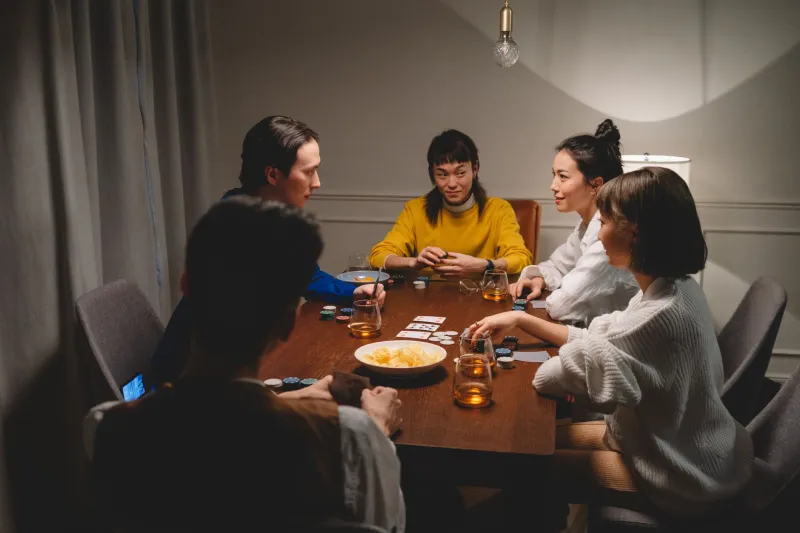
Most travel gadgets promise to solve a problem you didn't have. A deck of cards solves one you definitely do: how to sit near strangers without making it weird. It fits in a jacket pocket. It survives being stuffed into a backpack. It does not need a plug, a data plan, or a translation app. And unlike a phrasebook, it gives people something to do together instead of something to perform.
That's the quiet genius of carrying cards abroad. You are not arriving with an activity. You are arriving with an excuse to share a table.
The case for a 3.5-ounce conversation starter
A deck is flexible in a way most travel gear is not. In a hostel kitchen, it turns a awkward wait for pasta water into a group. On a long train ride, it gives seatmates a reason to stop pretending they aren't curious about each other. At a park table outside a national park visitor center, it keeps a picnic from ending too soon. It even works as a solo ritual—shuffling on a bench is a low-key way to look approachable without looking desperate for company.
Cards also level the field. A game has rules, turns, and a shared object in the middle. That structure does a lot of social work when two people don't share much vocabulary. You can point, nod, demonstrate, and laugh at the same bad draw. The deck doesn't open a border, but it opens a table.
For US travelers, the packing math is easy: this is cheaper than an airport sandwich and smaller than a paperback. Toss a standard 52-card deck plus jokers into a zip pouch next to your charger. Skip the novelty deck with text-heavy rules or risqué illustrations. You want boring cards. Boring cards travel everywhere.
How to let the cards do the talking
The fastest way to ruin the trick is to treat it like a trick. Don't walk up to strangers and announce that you have cards. Don't hover near a group waiting for your moment. Start by playing with your own travel companion, or by laying out a simple solitaire hand while you drink coffee. Curiosity is a better recruiter than enthusiasm.
If someone watches for more than a few seconds, make eye contact and lift the deck slightly. A questioning eyebrow does more than a sales pitch. Ask once—something simple like, Want to play?—and be ready to accept no. If the answer is no, smile, put the cards away, and go back to your book. The whole point is low pressure.
Good moments tend to be already social: a hostel common room, a train lounge car, a plaza bench, a campsite picnic table, a ferry deck. Bad moments are quiet cars on Amtrak, crowded commuter trains, religious spaces, formal restaurants, and any place where your game would block a walkway. Read the room before you shuffle.
When you do get a yes, teach by playing one open round. Don't explain for five minutes. Lay your hand face up, take a turn, and let the other person see the pattern. Gestures beat grammar. A pointed finger at a matching suit is worth a paragraph of instructions.
Three games that need almost no vocabulary
Memory, also called Concentration, is the easiest place to start. Lay pairs face down, take turns flipping two cards, and keep matches. You can play the whole thing with nods, shrugs, and a satisfied little tap on the table. It works with kids, grandparents, and people who have never played cards in their life.
War needs even less explanation. Each player flips the top card. Higher card takes both. If ranks get confusing, point to the numbers and use fingers for face cards. It is not a deep game, but it is fast, silly, and easy to abandon when the food arrives.
Crazy Eights is the next step up. Match the suit or the number, and demonstrate an open hand for one round. You can teach the whole game with two gestures and one example. For a group, a simple shedding game works well—everyone draws, everyone discards, first empty hand wins. Keep the rules light. The game is the excuse, not the event.
A quick etiquette pass
In Europe, train compartments can be social, but ask before joining. A simple gesture toward the empty seat and a lifted deck is enough. In Japan, keep the volume low, skip table-slapping games, and avoid crowded commuter trains; a park bench or a hostel lounge is a better fit. In much of the Middle East, offer the deck with your right hand, keep money far away, and read the room on mixed-gender groups. In Latin American plazas, a casual invite often goes a long way, but ask before pulling up a chair. In Southeast Asia, follow your host's lead on shoes and floor seating, and keep cards off surfaces used for food. In the US, remember that national park picnic tables are shared space—invite people in, but don't take over the whole shelter.
One rule covers most of it: the deck is an invitation, not a mandate. If someone hesitates, let it go.
When to put the cards away
Put them away when someone declines. Put them away when a game starts drifting toward betting, even playfully, because gambling rules and local norms vary and you don't want to be the traveler who misreads the room. Put them away around unaccompanied kids unless a guardian is clearly fine with it. Put them away in quiet cars, houses of worship, formal settings, and any spot where a small crowd would block a path. Put them away if alcohol is making things sloppy or if the group's body language has gone from curious to cornered.
And put them away when the trip gives you something better to do. A deck is a backup plan for connection, not a replacement for the place you came to see.
The souvenir that keeps dealing
You don't need a special deck. You don't need to be good at cards. You need a table, a little patience, and the willingness to look a stranger in the eye and deal one card across it. Every journey tells a story, and sometimes the first line isn't spoken. Sometimes it's dealt.